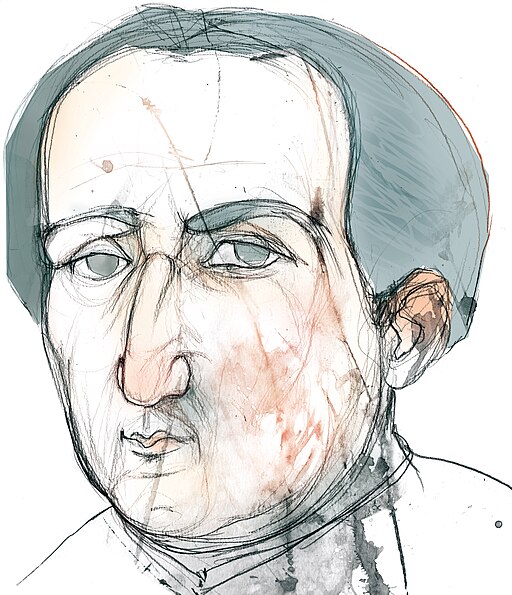
Abraham Zacuto
Salamanca-born Castilian astronomer, mathematician, and historian Abraham Zacuto (Portuguese: Abraão ben Samuel Zacuto; 1452 – c. 1515) served as Royal Astronomer to Portugal's João II after Spain's Catholic Monarchs issued their 1492 decree ordering the expulsion of the Jews. Before he relocated, Zacuto studied and worked at the university in Salamanca, producing Jibbur Hagado, an astronomical treatise in Hebrew, which was later translated into Latin and Spanish as Almanach perpetuum coelestium motuum (Almanac of the Continuous Movement of the Stars), and provided the first published tables that could be used to plot a ship's course. He also compiled a set of astronomical tables that could be used to assemble a perpetual calendar and predict the solar and lunar eclipses and the movement of the planets using relatively simple calculations.
During his time in Salamanca, Zacuto may have participated in the cosmographical discussions assessing Columbus's scheme to reach Asia by sailing westward. Columbus is known to have used Zacuotos tables on his voyages. Zacuto may have also worked in Zaragoza and Cartagena, so he was well-known in academic circles when he arrived in Lisbon.
Zacuto's duties as Royal Astronomer included tutoring pilots and navigators, constructing navigational instruments, and providing written instructions for the officers who used them. After advising João Ii on possible sea routes to India, Zacuto's last recorded service in Portugal involved briefing Vasco da Gama, his officers, and crew before their departure on the 1497 expedition to India. However, Manuel I's decree on Christmas Eve 1496 expelling all unconverted Jews from Portugal saw Zacuto leave Lisbon before da Gama did. During his stay in Tunis, he wrote a history of the world (Sefer Yohasin), then moved on to Jerusalem, where he may have died in 1515. However, some sources subsequently place him in Damascus, where he died five years later.