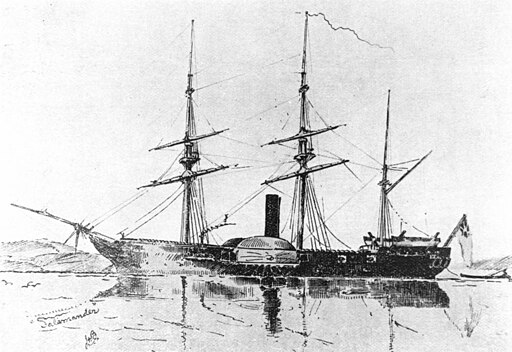
HMS Salamander
Built in the Sheerness Dockyard in 1831, the well-travelled 1,014-ton paddle steamer HMS Salamander was one of the Royal Navy's first steam powered vessels. Launched and completed in 1832, the Salamander was the eighth Royal Navy vessel to bear the name and was broken up in 1883.
After an initial commission in British waters (1832 to 1841) — largely in the English Channel and off the coast of Spain, she was recommissioned in June 1842 and joined the South America Station, before proceeding to the Pacific, where she served as an observer during the Franco-Tahitian War (1844 to 1846) before returning home via Jamaica to be paid off in November 1847.
Salamander's third commission (July 1850 to November 1854 ) took her to eastern waters for the took part in the Second Anglo-Burmese War (1852) and the Mediterranean. A fourth commission took her to Africa's west coast and the Arctic (via a stint at home), where damage caused by ice required extensive repairs, culminating in an 1863 rebuild.
Recommissioned in December 1863, the Salamander spent the next three and a half years on the Australia Station, where she transported the party to establish the settlement and coaling station at the tip of Cape York at Somerset and undertook survey work on the Great Barrier Reef. running aground on the reef off Cape Cleveland, which subsequently bore her name. After further survey work around Port Phillip and Wilson's Promontory and another grounding, she returned to Brisbane for repairs and then returned to England, where she went into the Steam Reserve in December 1867.
Over the next fifteen years, the Salamander served in a number of ancillary roles under a variety of commanding officers in Britiish waters before being sold and broken up