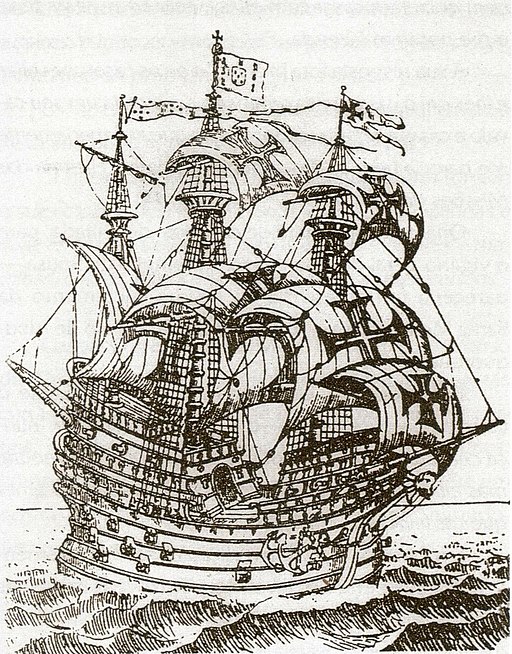
Carrack
The three- or four-masted carvel-built carrack (Portuguese: nau; Spanish: nao) was developed in Europe during the 14th and 15th centuries from the single-masted square-rigged cog. They evolved gradually, and the later carracks were square-rigged on the foremast and mainmast with a lateen-rigged mizzenmast with a high rounded stern and sterncastle and a forecastle and bowsprit at the stem. The largest carracks, such as the Flor de la Mar, were up to forty-five metres long and displaced more than a thousand tons.
Carracks were first used for trade from the Mediterranean to the Baltic. However, their size and capacity made them eminently suited to the longer voyages required by the developing Portuguese trade between Europe and India and the Spanish trans-Atlantic trade with the Americas. They were gradually superseded in the late 16th and early 17th centuries by the similarly rigged galleon, which had less cumbersome castles and a greater length relative to their beam.